
Bringing a puppy home is one of the happiest moments in life. The excitement, the tiny paws running around, the unconditional love—it all feels magical. But along with this happiness comes a responsibility that many new pet owners underestimate: potty and pee training.
Almost every dog owner goes through this phase. Your puppy urinates anywhere, poops multiple times a day, and doesn’t seem to understand what is right or wrong. Slowly, frustration builds up. Family members start complaining. Some even regret bringing the puppy home.
But here’s something very important you need to understand right from the beginning:
- Your puppy is not being naughty.
- Your puppy simply doesn’t know what to do.
The good news is, with the right approach, patience, and consistency, you can train your puppy’s potty habits up to 80–90% within just 5 to 10 days.
This guide will walk you through everything in a simple, practical, and realistic way—just like an experienced pet owner would explain.
Why Puppies Pee and Potty Everywhere
Before you try to fix the problem, you must understand the root cause.
Puppies, especially between 2 to 5 months of age, have:
- Very small bladder control
- High metabolism
- No understanding of “correct place”
They don’t think like humans. They don’t know that your living room is not a toilet.
For them, the entire house is just one big space.
Typical Puppy Behavior:
- Wakes up → Needs to pee immediately
- Eats food → Needs to poop within minutes
- Plays a lot → Drinks water → Pee again
This is completely natural.
So instead of getting angry, focus on guiding them.
The Real Problem Most Owners Face
Let’s be honest. The biggest issue is not the puppy—it’s the situation around it.
Many people say:
- “Who will clean this again and again?”
- “We don’t have time for this.”
- “The house smells bad.”
- “We don’t have space to take him outside.”
Sometimes:
- Husband gets irritated
- Wife feels overwhelmed
- Kids lose interest
- Elderly people complain
This becomes a family issue, not just a pet issue.
But here’s the truth:
- Cleaning is not the solution.
- Training is the solution.
If you don’t build the habit, you’ll keep cleaning forever.
What You Need Before You Start Training
Let’s keep it simple. You only need a few things:
1. Pee Pads
These are absorbent mats that soak urine, just like a diaper. They help define a specific toilet area.
2. Potty Training Spray
This spray has a smell that attracts puppies and encourages them to pee at that spot.
Dogs naturally rely on smell. If a place smells like a toilet, they will use it again.
3. Tape or Fixing Material
To keep the pad in place. If the pad moves, the puppy gets confused.
4. Training Treats
Small rewards that you give when your puppy does the right thing.
This is very important because dogs learn faster with rewards.
Step-by-Step Potty Training Process
Now let’s come to the most important part.
Step 1: Choose a Fixed Spot
Decide one place in your house:
- Balcony
- Washroom corner
- Parking area
- Lawn
Do not keep changing the location.
Consistency is everything.
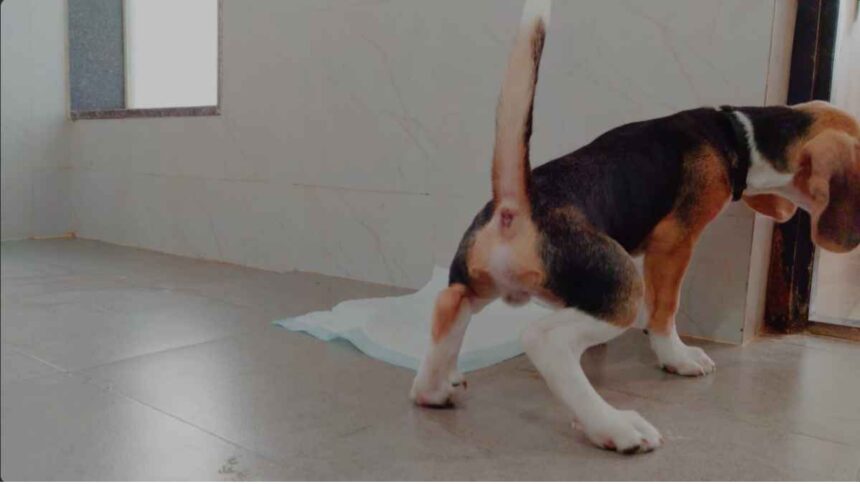
Step 2: Set Up the Pee Pad
- Place the pad on the floor
- Stick it properly with tape
- Make sure it doesn’t move
Now spray 3–4 times directly on the pad.
Do not spray outside the pad.
This scent will guide your puppy.
Step 3: Understand Timing
Timing is the key to success.
You must observe your puppy carefully.
Take your puppy to the pad:
- Immediately after waking up
- After eating food
- After playtime
These are the moments when they are most likely to pee or poop.
Step 4: Pick and Place Method
A small puppy cannot walk far when it urgently needs to pee.
So don’t wait.
Pick your puppy and place it on the pad.
Even if it’s just a few steps away, carry them.
Repeat this process multiple times daily.
Step 5: Reward Immediately
This is where magic happens.
Whenever your puppy:
- Pees on the pad
- Poops on the pad
Immediately:
- Say “Good Boy” or “Good Girl”
- Give a small treat
- Pet them lovingly
This creates a strong connection in their mind:
“If I do this here, I get something good.”
Step 6: Repeat Again and Again
Training is not a one-time effort.
You may need to repeat this:
- 10–20 times a day
Yes, it sounds like work—but it’s temporary.
Within a few days, your puppy will start going to the pad on its own.
What to Do When Your Puppy Makes Mistakes
Mistakes will happen. That’s normal.
When your puppy pees somewhere else:
- Say “NO” in a firm voice
- Take them to the pad
- Do not hit aggressively
Dogs understand tone, not language.
If you shout too much or hit hard:
- The puppy may become scared
- It may start hiding while peeing
That makes training even harder.
Night Routine – The Most Ignored Step
This is where many owners fail.
Let’s see what usually happens:
- Puppy eats at 9 PM
- Family sleeps at 11 PM
- Puppy plays and then pees somewhere at night
Wrong approach.
Correct Method:
Before sleeping:
Take your puppy to the pad once
Let them pee before going to bed.
This helps:
- Longer sleep
- Fewer accidents at night
Feeding Routine and Its Impact
Food plays a big role in potty habits.
Important Points:
- Feed 3–4 times a day
- Do not overfeed
- Maintain fixed timing
Overfeeding leads to:
- Frequent potty
- Loose motion
- Digestive issues
Good quality dog food helps in:
- Better digestion
- Less frequent potty
How Long Will It Take?
If you follow everything properly:
- Day 1–2 → Puppy starts noticing
- Day 3–5 → Begins to understand
- Day 5–10 → 80–90% trained
But remember:
Consistency is more important than perfection.
Building Trust and Bond
Training is not just about discipline.
It’s also about relationship.
When you:
- Feed them with your hand
- Talk gently
- Pet them
They start trusting you.
And a dog that trusts you:
Listens to you better
Learns faster
Common Mistakes to Avoid
Let’s quickly go through some mistakes:
- Changing potty location frequently
- Not rewarding good behavior
- Ignoring timing
- Overfeeding
- Getting angry too often
Avoid these, and your training will become much easier.
The Reality Check
Many people expect:
“My puppy will learn automatically.”
But that doesn’t happen.
Dogs learn from:
- Repetition
- Rewards
- Guidance
If you don’t train:
The puppy will create its own habits
And those habits are usually not what you want.
Final Thoughts
Potty training may feel frustrating at first, but it’s actually one of the easiest things to fix—if done correctly.
Instead of thinking:
“Why is my puppy doing this?”
Start thinking:
“How can I guide my puppy better?”
Because once the habit is formed:
- Your home stays clean
- Your stress disappears
- Your bond becomes stronger
Conclusion
If you truly put in effort for just a few days, you will see a massive improvement.
Remember:
Be consistent
Be patient
Reward good behavior
Guide, don’t punish
Your puppy is like a baby.
And just like a baby, it learns with love, care, and repetition.
Start today, and within a week, you’ll notice the difference.